
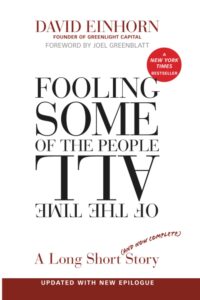
Fooling Some People All of the Time: A Long Short Story by David Einhorn
Einhorn details taking a market bet against Allied Capital based on his diligence and subsequent belief that the company’s valuation was built on top of fraudulent accounting practices. The backdrop of his battle to have other public investors and regulators see what he did in Allied takes place between 2002 and 2008—the lead up to the Financial Crisis. Einhorn energetically lays out his diligence approach, what raised red flags for him, and how he went about answering the additional questions that fell out of the potential red flags. This is a must read for those who enjoy due diligence and the art of being a business detective, no matter if you play in the public or private markets.
Key Takeaways:
- Start with the basics: Look at the accounting and spin out your analysis from there. By looking at the fundamentals of the business and digging deep into the numbers, Einhorn was able to see discontent from the market price, what the company was reporting, and reality.
- Dig where there are inconsistencies. Do not rely on numbers alone. Tie qualitative and quantitative research together. When the two disagree, your understanding of the circumstances may be incomplete, there may be missing information, or the way the numbers are being presented may be off. Great research looks to square differences in data sources and tick and tie them to get a more complete investment picture.
- Challenge your assumptions. Be humble enough in your thinking to know that you may be wrong.
Tips for M&A Professionals:
- Math is apolitical. What and how something gets counted is not. The way data are recorded into a POS, CRM, or enterprise accounting package is ultimately governed by policies and human action. Getting to the proper form of accounting or broader understanding of the cash generation capacity of the business sometimes requires comparing the quantitative with the qualitative to bring about a clearer picture. When the qualitative does not match the quantitative in key underwriting items, one is best to resist the urge to shrug off the information without understanding it. Bridge the divide to get to a better underwriting decision.