
“This Should Exist For Women:” The Story of Spanx
It is a truth universally acknowledged that a woman in possession of legs and a waist must be in want of a decent pair of pantyhose. At least, that is the conclusion that 27-year-old Sara Blakely arrived at while selling fax machines door-to-door in her first post-graduate job. Blakely, perhaps better known as the founder and owner of Spanx, first conceived of her product simply by trying to find a suitable undergarment for a particular pair of cream-colored pants.
Blakely wanted to wear control top pantyhose under her pants, which are meant to smooth and flatten around the stomach, hips, and waist, but she became frustrated with how the seams at her feet were glaringly apparent in open-toed shoes. Everyone would know she was wearing control top pantyhose, which – in case you are a person who has had the good fortune to never wear pantyhose – completely defeats the point. In a fit of exasperation, Blakely took up a pair of scissors (a familiar experience for any woman who has ever gotten dressed for a party) and cut the feet off of her pantyhose.
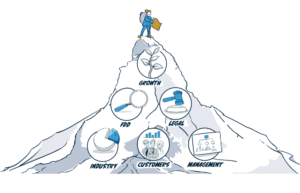
Blakely was thrilled with the results. She felt confident wearing her cream-colored pants and recalls thinking to herself, “this should exist for women.” The only problem with her makeshift solution was that, without the stockinged feet, the pantyhose kept rolling up her legs. Led by a firm belief that her idea would be successful, Blakely began exploring the possibility of developing the product herself. She took a week off from her job selling fax machines in Georgia and drove to North Carolina to pitch her product idea to hosiery mills in person, but with no business or design experience, no corporate support, and a mere $5,000 in personal savings, Blakely was politely shown the door by every mill.
She encountered similar barriers on the legal front. Based on her lack of success in pitching her idea to the male owners of hosiery mills, Blakely sought out a female patent attorney in Georgia, as she intuited that a woman might better understand her product’s value proposition. But she was surprised to learn that no female patent attorney existed in the entire state. She resorted to soliciting male attorneys to patent a product that would, in her words, “change the world and make women’s butts better.” Blakely met with multiple lawyers to get an idea for what it would take to patent her design, but no lawyer would compose the patent paperwork for less than $3,000, which was simply an unaffordable sum.
Even worse, the attorneys clearly devalued her idea. Blakely says that one attorney later revealed he “thought…your idea was so bad that I thought you had been sent by Candid Camera.” Blakely knew she had a great product but kept running into the same roadblock: men who did not understand the value proposition. She continued the patent process by herself using a book on writing patents and trademarks as a guide.
Meanwhile, Blakely finally found some movement on the manufacturing side. A hosiery mill owner she had met with in North Carolina called to inform her that he would undertake her design. He had shown the idea to his two daughters, and they convinced him of its value. But while women had helped push her idea into production, Blakely was again surprised to find that there were no women involved in the hosiery production process, almost to a comical degree. Pantyhose across all sizes were being made with the same waistband size (just in case you were wondering, this makes for extremely uncomfortable pantyhose), and sizing was determined by putting a product onto plastic mannequins rather than being tested by people with real bodies who might offer feedback on fit and comfortability. Blakely determined to make her product differently: she tested her prototypes on friends, family, and of course herself to solicit feedback and make improvements to her product.
For over a year and a half of the product development process, Blakely had been trying find the right name for her product. She wanted something snappy that included the “k” sound based on the recognizability of brand names like Coke and Kodak. The name “Spanks” came to her out of the blue, and she knew immediately it was a winner, especially compared to the runner up, “Open-Toed Delilahs.” For $350, Blakely trademarked her brand name, and at the last second swapped the “ks” to “x” after reading that made up words tend to sell better.
When it came time to sell her product, Blakely took the same approach she had used in almost every other aspect of her young business and did it herself. With only ten minutes to deliver her pitch, she convinced the buying rep at Neiman Marcus to purchase Spanx by personally modeling them – under her cream-colored pants, of course. Blakely soon acquired deals with major department stores and distributors, including Saks Fifth Avenue, Bloomingdale, Bergdorf Goodman’s, and QVC Channel. She mailed her product to Oprah, and Spanx was then featured in “Oprah’s Favorite Things” list. Spanx became profitable in its very first year of business with a total revenue of $4 million.
Today, Spanx is a household name synonymous with shapewear and hosiery. Blakely’s wildly successful idea earned her the title of the youngest self-made female billionaire in 2013, and Spanx is widely regarded as a female-forward brand. While it is still a private company, Blakely sold a majority stake of the business to Blackstone in 2021 for $1.2 billion; the deal was led by an all-female investment team. Blakely is currently the Executive Chairwoman on the company’s all-female Board of Directors, a fitting position for a woman who championed her own product in male-dominated spaces and led it to unprecedented success.