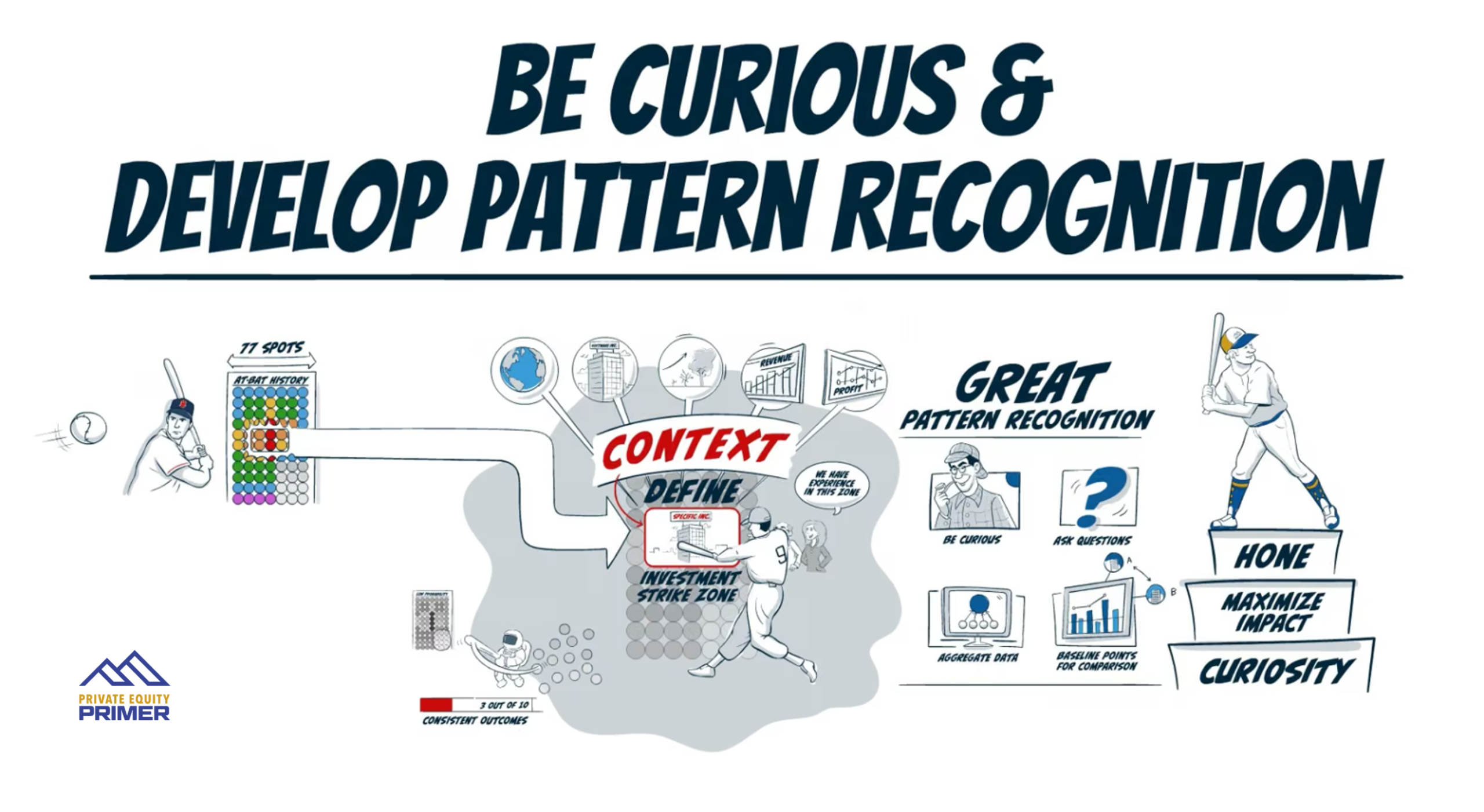
The typical major leaguer’s batting average is a mere .250 Red Sox legend Ted Williams holds a lifetime batting average of .344 spanning a nineteen-year career. What set Williams apart from others was his ability to systematically spot patterns. In fact, his obsession with spotting the patterns in his own performance is so legendary that Warren Buffett wrote in the 1997 Berkshire Hathaway shareholder letter about how Berkshire tries to emulate Williams’s approach to hitting to Berkshire’s investing
Pattern recognition is a cornerstone of both successful hitting and investing. Leveraging curiosity and seeking insights creates consistent results and at times a competitive edge. Many private equity groups organize themselves around pattern recognition. All the quantitative and qualitative factors that make up their investment box help the private equity group leverage pattern recognition—from geography restrictions, industry specialization, growth stage, revenue and profitability attributes—these all help the firm maximize their understanding of specific businesses in specific contexts. They represent Williams’s pattern recognition in the strike zone, letting the private equity firms know when to swing hard and when to let the pitch sail by.
When information is abundant, context is what is scarce. Great pattern recognition requires being curious, asking questions, aggregating data, and establishing a baseline for points of comparison. The diligence process is a form of context creation organized around an investment box and investment thesis. Seek out the patterns.
Get the latest stories delivered straight to your inbox.
PE Primer uses cookies and similar technologies on this website to improve your website experience, for marketing, to enhance the website’s functionality, and to monitor and record activities and communications on the website. If you continue to use this site, you agree to our Privacy Policy, Terms of Use and Cookie Policy.