
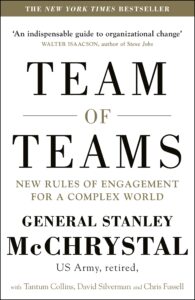
Team of Teams: New Rules of Engagement for a Complex World by Stanley McChrystal, Tantum Collins, David Silverman, and Chris Fussell.
Using his time as commander of a Joint Special Operations Command during the War on Terror as the backdrop for his ideas, retired U.S. Army General Stanley McChrystal reflects on his personal experience and details how successful teams are organized. He shows how Al Qaeda remained elusive and dangerous to the world’s most formidable military power despite their size and lack of technology and explains how the U.S. military adapted to become flexible and transitioned to combat decentralized terrorist groups. McChrystal and his co-authors describe this approach as a Team of Teams. The Team of Teams approach stands in contrast to the more hierarchal and bureaucratic structures common to large old economy-focused organizations. McChrystal and team apply their Team of Teams lens to identify nimble operational excellence across industries in the private sector, government, and medicine. In doing so, they demonstrate how specialized teams with multiple integrated hierarchies prove more flexible, agile, and able to execute than previous iterations of teams with fixed and purely hierarchal structures.
Team of Teams illustrates how the structure of a group—or, more aptly, the structural flexibility of a group—can determine how obstacles are overcome. At first, McChrystal’s detailed illustrations of military strategy may feel like an extreme example to connect with corporate deal strategy, but the author spends a significant amount of effort enumerating the civilian industries, both public and private, in which he sees his strategy work reflected. McChrystal’s examples are continuously engaging to read and emphasize how the structural strategy of any professional team can make a difference in navigating tasks and obstacles.
Key Takeaways:
▪ Elongated informational distance is where risk lurks for leaders and their teams. The authors show multiple examples of how traditional fixed hierarchical structures require information to go up to the top and be distributed horizontally between departments. This is slow and increasingly unreliable in a complex and networked world. Delays in sharing information and then actualizing it costs life on the battlefield, fixes in consumer products that caused bodily injury, and costs shareholders unrealized profits. Their Team of Teams approach is designed around shortening informational distance while still managing coordination costs.
▪ Communication is essential to a team’s success. McChrystal speaks frequently about successful teams as networks. While these networks often operate with decentralized management, they practice centralized communication that allows teams to operate quickly and efficiently with the necessary information. This structure creates flexible and adaptable teams that can operate effectively without much supervision or oversight, which frees up supervisory resources to tackle additional tasks and allows for quicker, concentric work.
▪ Attitude, and dedication to the team, accounts for a lot of the work. Navy SEALs training is notorious for its physical brutality, but even cadets who exhibit peak physical capabilities sometimes fail the training. McChrystal suggests that the cadets who regularly succeed at Navy SEAL training enter the program with a desire to contribute rather than a need to prove and that this attitude of commitment and contribution makes a significant mental difference. The authors suggest those with great desire to contribute make for better employees and leaders.
▪ A flexible team can win consistently. McChrystal uses his experience as commander of the Joint Specialized Operations Command (JSOC) as the primary backdrop for illustrating this point. Despite the success the U.S. military found in adherence to a rigid structure previously, terrorist groups continued to outwit and inflict damage on U.S. troops in the Middle East. General McChrystal and his colleagues cite a shift away from traditional structure as a major reason for success in the fight against Al Qaeda. Teams that can adapt to their environment rather than try to force their structure to operate within different circumstances will be able to reach their goals in any situation. The chief reason is consistently organizing efforts around a clearly communicated goal to convert information into action more quickly. In short, in the authors’ view, success in the modern business environment requires shortening the time from data acquisition and analysis to action.
Tips for M&A Professionals:
▪ Deal teams are structured as top-down hierarchies. However, job titles do not always equate to the ease of access and level of understanding of information. One can add value to their deal team by getting clear on who needs what information when to make critical decisions.
▪ For due diligence providers, like TAS and commercial due diligence advisors, this means identifying potential deal killers of crucial curve balls in your workflows that require immediate calls to the client.
▪ For investing professionals, empower your network of advisors to have insights into your decision-making process and key underwriting decision gates. Doing so gives your Team of Teams the visibility needed to assist you in closing the gap from information to insights.